
When exploring East Asian languages, Chinese and Japanese often get confused by Westerners due to their use of characters and rich cultural heritage. While they share some visual similarities in writing, these languages have distinct characteristics that set them apart in profound ways.
Difference Between Chinese and Japanese
Visual Differences in Writing Systems
Chinese and Japanese writing systems look similar at first glance, but they function quite differently:
Chinese (Hanzi) uses a single writing system based entirely on characters, where each character represents a concept or meaning. Modern Chinese mainly uses simplified characters (used in Mainland China) or traditional characters (used in Taiwan and Hong Kong).
Japanese (Kanji, Hiragana, Katakana) employs a mixed writing system with:
- Kanji: Characters borrowed from Chinese
- Hiragana: Curved, flowing phonetic symbols (あ, い, う, え, お)
- Katakana: Angular phonetic symbols used for foreign words (ア, イ, ウ, エ, オ)
This visual distinction makes Japanese text easily identifiable by the presence of these three scripts intermixed.
Pronunciation and Tonal Differences
Another major difference lies in pronunciation:
Chinese is a tonal language where the pitch or tone used to pronounce a word affects its meaning. Mandarin Chinese has four main tones, while Cantonese has six or more.
Japanese is not tonal. The pitch may change for emphasis or questions, but changing tone doesn't alter the fundamental meaning of words.
Grammatical Structure
The languages also differ significantly in grammatical structure:
Chinese follows a subject-verb-object structure similar to English (我吃饭 - "I eat food").
Japanese typically uses a subject-object-verb structure (私はご飯を食べます - "I food eat").
How to Tell Chinese and Japanese Apart
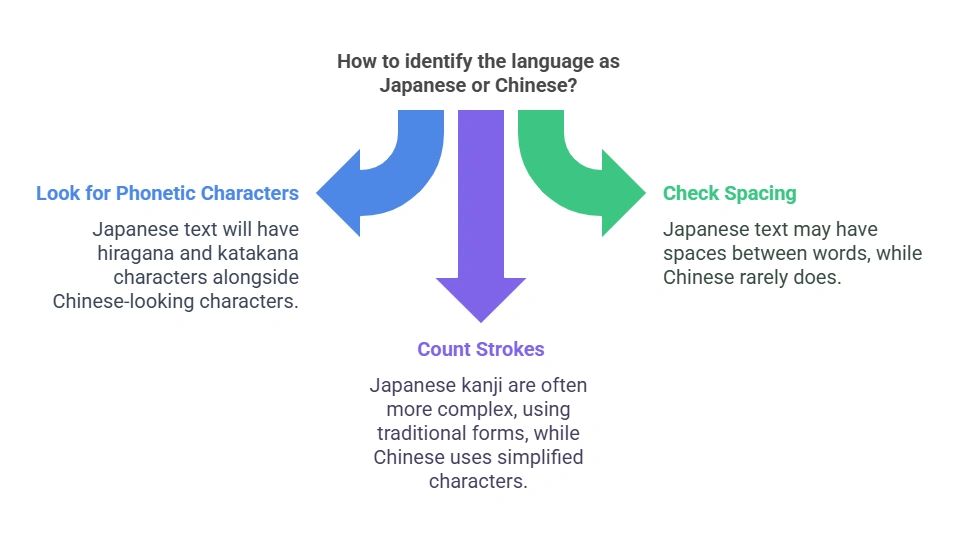
For those unfamiliar with East Asian languages, here are quick ways to identify whether you're looking at Chinese or Japanese:
- Look for hiragana and katakana: If you see curved (あ) or angular (ア) phonetic characters alongside Chinese-looking characters, it's Japanese.
- Check the spacing: Japanese text may have spaces between words in some contexts, particularly in children's books or learning materials. Chinese rarely uses spaces between words.
- Count the strokes: Japanese kanji often appear more complex because they tend to use traditional forms, while Mainland Chinese uses simplified characters.
Readers Also Liked: is Mandarin the same as Chinese?
Can I Understand Chinese if I Know Japanese?
While there is some crossover in the writing systems, knowing one language doesn't automatically enable understanding of the other. Here's why:
- Many kanji in Japanese share origins with Chinese characters, but their meanings and pronunciations often differ.
- A Japanese speaker might recognize some common Chinese characters, but understanding full sentences would be difficult due to grammatical differences.
- The phenomenon of "false friends" - words that look similar but have different meanings - is common between the two languages.
Is It Easier to Learn Chinese or Japanese?
This question comes up frequently among our students at Tampa Language Center, and the answer depends on several factors:
Factors favoring Chinese:
- Simpler grammar with no conjugations
- No gender distinctions for nouns
- More logical connection between written characters and spoken words
Factors favoring Japanese:
- Consistent pronunciation rules
- No tones to master
- Hiragana and katakana provide a more accessible entry point
At Tampa Language Center, we find that English speakers often adapt more quickly to Japanese initially, but progress in Chinese can accelerate once the tonal system is mastered. Your personal learning style and preferences will significantly impact which language feels "easier" to you.
Related: The best ways to learn Mandarin Chinese
Learn Chinese and Japanese at Tampa Language Center
Whether you're interested in Japanese for anime and manga or Chinese for business opportunities, Tampa Language Center offers comprehensive language programs to help you achieve your goals. Our experienced instructors use a variety of teaching methods to accommodate different learning styles.
Our Chinese and Japanese programs include:
- Beginner to advanced level classes
- Business language focus options
- Cultural context and practical usage
- Small group or private lessons
We've been teaching languages in Tampa since 1988, and our TEFL-certified instructors create engaging, effective learning experiences for all students. Whether you're learning for business, education, or personal enrichment, we adapt to your schedule with classes that fit your professional needs.
Start Your East Asian Language Journey Today
Understanding the differences between Chinese and Japanese is just the beginning. Immerse yourself in these fascinating languages and cultures with Tampa Language Center. Contact us today to discover which language might be the right fit for your goals and learning style!
Remember, whether you choose Chinese with its logical character system or Japanese with its unique mixture of scripts, our dedicated educators will guide you through every step of your language-learning journey.