If you've ever found yourself pausing mid-sentence, wondering whether to say "me gusta" or "mi gusta," you're not alone! The confusion between "me" and "mi" is one of the most common stumbling blocks for English speakers learning Spanish. Let's clear up this 'Me vs. Mi' confusion once and for all.
Me vs Mi in Spanish: The Summary
Understanding "Me" - The Object Pronoun
"Me" in Spanish is an object pronoun that means "me" or "to me" in English. It's used when you're the recipient of an action or when expressing what you like or dislike.
When to Use "Me":
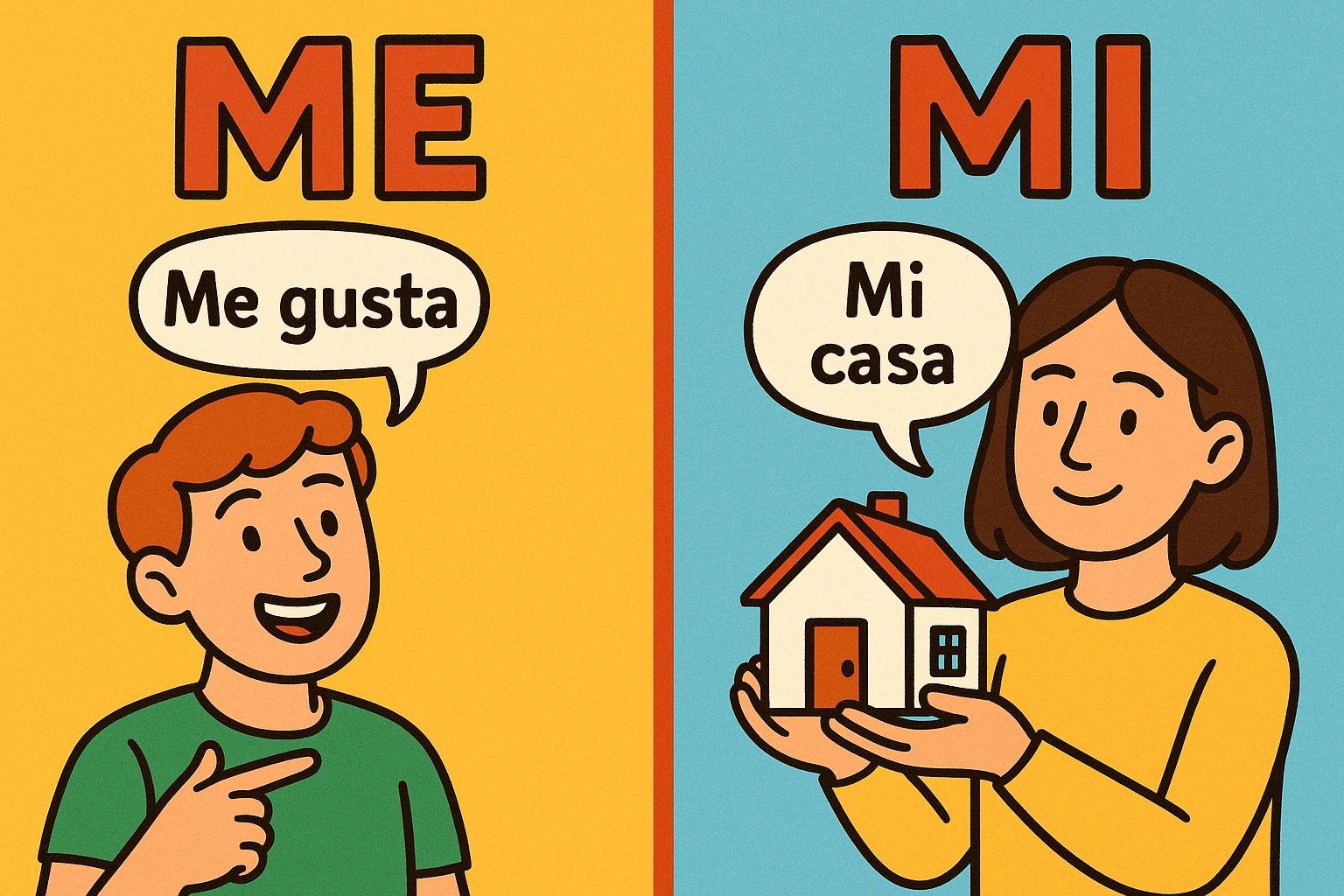
- With gustar (to like): "Me gusta la pizza" (I like pizza)
- As a direct object: "Él me ve" (He sees me)
- As an indirect object: "Ella me da el libro" (She gives me the book)
- With reflexive verbs: "Me lavo" (I wash myself)
Common "Me" Expressions:
- Me duele (it hurts me)
- Me parece (it seems to me)
- Me llamo (my name is/I call myself)
- Me encanta (I love it)
Understanding "Mi" - The Possessive Adjective
"Mi" is a possessive adjective that means "my" in English. It shows ownership or relationship and always comes before a noun.
When to Use "Mi":
- Showing possession: "Mi casa" (my house)
- Family relationships: "Mi hermana" (my sister)
- Personal belongings: "Mi coche" (my car)
- Abstract concepts: "Mi opinión" (my opinion)
Important Note About "Mi":
Unlike English "my," Spanish "mi" doesn't change form regardless of the gender of the noun it modifies. Whether it's "mi hermano" (my brother) or "mi hermana" (my sister), "mi" stays the same.
Common Mistakes to Avoid
❌ Wrong: "Mi gusta la música" ✅ Right: "Me gusta la música"
❌ Wrong: "Me hermano es alto" ✅ Right: "Mi hermano es alto"
❌ Wrong: "Dámelo me libro" ✅ Right: "Dame mi libro"
Memory Tricks That Actually Work
- "Me" = Action comes TO me: Think of "me" as receiving something
- "Mi" = MY stuff: "Mi" always shows ownership
- Position matters: "Me" usually comes before verbs, "mi" always comes before nouns
Practice Makes Perfect
Try these fill-in-the-blank exercises:
- ___ gusta estudiar español. (I like studying Spanish)
- ___ profesora es muy paciente. (My teacher is very patient)
- ¿___ puedes explicar la lección? (Can you explain the lesson to me?)
Answers: 1. Me, 2. Mi, 3. Me
Cultural Context: Spanish Around the World
Understanding "me" vs "mi" becomes even more important when you consider that Spanish is spoken across numerous countries, each with unique cultural expressions. Learning about facts about Spanish-speaking countries can enrich your understanding of how these pronouns are used in different contexts.
Whether you're planning to visit Spain's vibrant cities or explore Latin America's diverse landscapes, mastering these basics will enhance your travel experience. Check out our guide to the best Spanish-speaking countries to visit to see where your Spanish skills could take you!
Why This Matters for Your Spanish Journey
Mastering "me" and "mi" isn't just about grammar, it's about communicating clearly and confidently. These pronouns appear in countless daily conversations, from introducing yourself ("Me llamo...") to talking about your family ("Mi familia...").
Take Your Spanish to the Next Level
Ready to conquer more Spanish challenges? At Tampa Language Center, we've been helping students navigate these linguistic hurdles for over 35 years. Our experienced TEFL-certified instructors understand exactly where English speakers struggle with Spanish and have developed proven methods to overcome these obstacles.
Whether you're just starting with basic pronouns or preparing for advanced conversation, our Spanish classes in Sarasota are designed to build your confidence step by step. We offer flexible scheduling with group, semi-private, and private class options to fit your learning style and schedule.
Don't let pronoun confusion hold back your Spanish progress. With the right guidance and practice, distinguishing between "me" and "mi" will become second nature. Soon you'll be using both with the confidence of a native speaker!
¡Buena suerte with your Spanish studies!